AI safety and judgment, part 2: hallucinations, bias, copyright and policy
Gemini can be confidently wrong, quietly unfair, or borrow someone else's work. Know the four risks and the one-line disclosure habit.
Hallucinations: confident and wrong
A hallucination is an answer that sounds right and is not. Gemini may invent a statistic, a quote, a regulation, a product feature, a file that does not exist, or a person. It does not warn you. The sentence reads exactly like a true one.
Where they happen most:
- Specifics with no source: figures, dates, names, references.
- Things that should exist: “the standard form”, “the usual clause”.
- Gaps in a document: when summarising, it fills what the document does not say with a plausible guess.
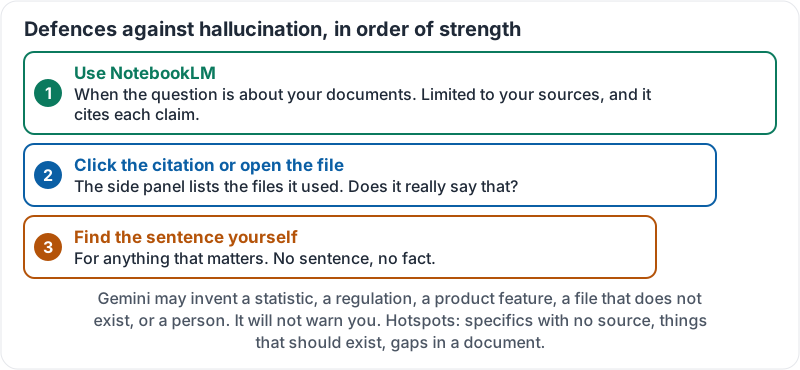
Defences, in order of strength:
- Use NotebookLM when the question is about your documents; it is limited to your sources and cites them.
- Click the citation or open the file the side panel used. Does it really say that?
- For anything that matters, find the sentence in the source yourself. No sentence, no fact.
The three defences, strongest first:
Bias: quietly unfair
Gemini learned from human writing, which carries human assumptions. Unchecked, AI drafts can assume a nurse is “she” and an electrician is “he”, rank job applicants on names or career gaps, or write more warmly to one customer than another.
Two habits. Never let the AI decide about a person: hiring, firing, pricing, credit, housing, discipline. Use it to draft and organise; a person decides. And when you ask for anything that compares people, ask Gemini to list the criteria it used, then check them.
Copyright: whose work is this?
Output you create at work is generally yours to use, with two cautions:
- Do not ask it to reproduce someone else’s work. “Rewrite this competitor’s brochure so it’s ours” is a copyright problem whoever types it.
- Images: no other companies’ logos, characters or products in anything the public sees; no real people without consent; label generated images that could pass for photographs.
If a long passage reads like a quote from a real book, article or song, assume it may be one and do not publish it.
Your company AI policy
Most small businesses now have a short AI policy. It usually says:
- Which tools and accounts are approved (for Gemini: usually the Workspace account only).
- What may be pasted (the three buckets from part 1).
- Which tasks need a human decision.
- When AI use must be disclosed.
If you have not read yours, ask for it today. If there is none, these two lessons are a safe default.
Disclosure: the one-line habit
| Situation | Disclose? | How |
|---|---|---|
| Internal draft you edited and own | Usually no | It is your work |
| Customer-facing text you edited and checked | Follow policy | Often no, as long as a person reviewed it |
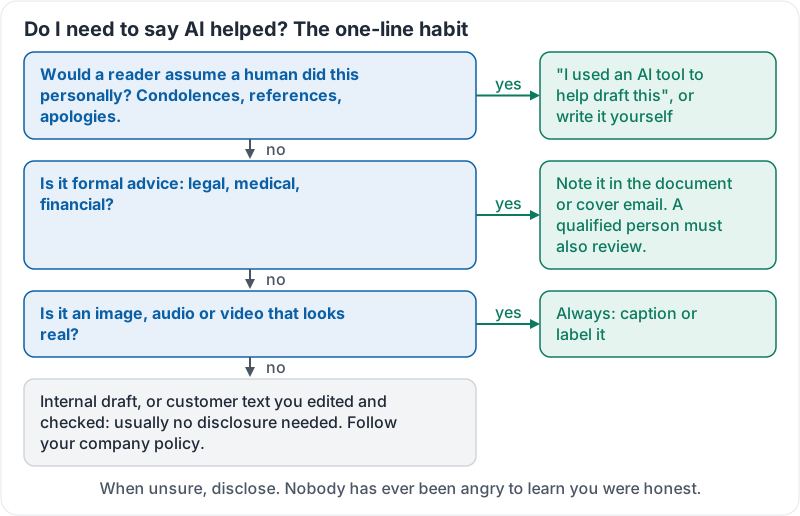
| Anything a reader assumes you wrote personally: condolences, references, apologies | Yes, or write it yourself | “I used an AI tool to help draft this” |
| Formal documents: legal, medical, financial | Yes, and a qualified person reviews | Note in the document or cover email |
| Images, audio or video that look real | Yes, always | Caption or label |
When unsure, disclose. Nobody is upset to learn you were honest.
The same rules as a quick decision path:
Try it now
Find your company AI policy, or ask who owns it. Compare it with lessons 7 and 8 and note one thing it adds and one thing it misses. If there is no policy, write three sentences that could start one and send them to your manager.
Remember: a fact that matters needs a source you opened, people decisions stay with people, do not borrow others’ work, and disclose when a reader would want to know.
Checking your progress…