AI safety and judgment, part 1: what never to paste
Some information must never go into an AI chat, some needs the names removed first, and most is fine. Learn the three buckets.
The three buckets
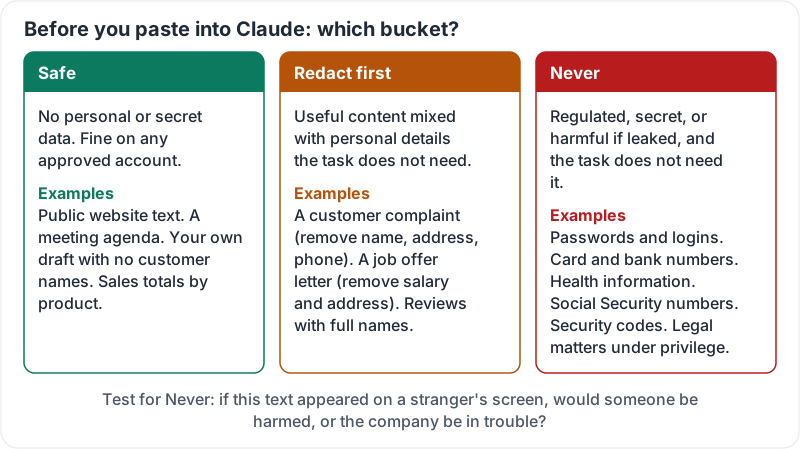
Every time you are about to paste something into Claude, it falls into one of three buckets.
| Bucket | Meaning | Examples |
|---|---|---|
| Safe | No personal or secret data. Fine to paste on any approved account | Public website text, a meeting agenda, your own draft email with no customer names, sales totals by product |
| Redact first | Useful content mixed with personal details that are not needed for the task | A customer complaint (remove name, address, phone), a job offer letter (remove salary and address), reviews with full names |
| Never | Data that is regulated, secret or could harm someone if it leaked, and the task does not need it | Passwords and logins, card or bank numbers, health information, Social Security numbers, security codes, legal matters under privilege |
The test for “never” is simple: if this text appeared on a stranger’s screen, would someone be harmed, or would the company be in trouble with a regulator or a customer? If yes, it does not go in.
The three buckets with examples:
Personal information: redact first
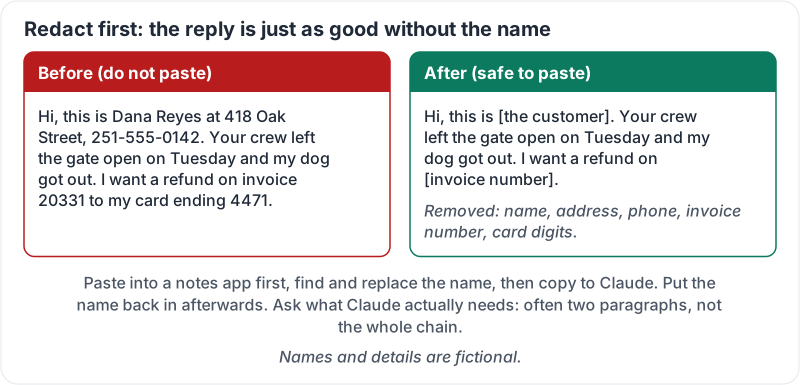
Most work content involves people. Claude can help with it, but it rarely needs to know who. Replace names with roles (“the customer”, “Employee A”), remove phone numbers, emails and addresses, and strip account numbers. The reply you get back is just as good, and you put the name back in afterwards.
Quick redaction habits:
- Paste into a notes app first, use find and replace on the name, then copy to Claude.
- For long threads, ask yourself what Claude actually needs. Often it is two paragraphs, not the whole chain.
- On a phone, read the paste once before you hit send. Signatures and quoted replies carry a lot of personal detail.
A complaint before and after redaction. The reply you get back will be just as useful:
Passwords, payment and health: never
Three categories are off limits on any plan, personal or work, unless your company has explicitly set up an approved process:
- Credentials: passwords, PINs, API keys, Wi-Fi codes, door codes, admin logins. An AI chat is not a password manager.
- Payment data: card numbers, bank account and routing numbers, CVV codes, full statements.
- Health data: diagnoses, doctor’s notes, medications, anything about a named person’s health. This is regulated and the fines are real.
If a task seems to need one of these, the task is wrong, not the rule. A note for payroll about an absence does not need the diagnosis. Instructions for a new hire do not need the actual password.
The account changes the line
Lesson 1 covered personal versus work accounts. The buckets shift with the account:
- On a personal or consumer account, even “redact first” content may be off limits under your company policy, because the company has no control over that data.
- On a company team plan, redacted customer content is usually fine, and the “never” bucket still applies.
When in doubt, the question to ask your manager is: “Which account, and which bucket?”
Try it now
Open your last five chats with Claude or any AI tool. For each one, decide which bucket the pasted content was in. If anything landed in “redact first” or “never”, delete that chat and note what you would do differently.
Remember: safe, redact first, never. Passwords, payment details and health information are always never. Names and contact details come out before the paste.
Checking your progress…